
Give the work
an organization.
Define who does what, who reports to whom and which tools each role can use. Alchemy expresses the team’s structure in an organization description, with reference teams you can adapt to your work.
Alchemy is where you manage, watch and govern teams of AI agents. Describe the team once: roles, reach, approvals and budget. Alchemy runs it on your infrastructure, shows every agent at work, holds anything you mark for a person, and keeps a record you can prove.
A chatbot hands you an answer and leaves the work to you. A framework hands you building blocks and leaves the wiring to you. Alchemy hands you the work: the memo, the deck, the checked draft, each on the Board as it lands, with the record of every step behind it.
Twelve projects like these ship with Alchemy, across eight industries. Each is a starting point you edit, not a team you write from scratch.
The pilot worked. Then finance asked what it would cost at scale, and security asked who approved the actions. Nobody in the room could answer.
Three numbers, one gap. Nobody could see what the agents were doing, nobody had decided what they were allowed to do, and nobody could prove what they did.
A harness gives an agent the machinery to work: tools, context and an execution loop. Modern frameworks also offer memory, orchestration and human approval.
Those capabilities still need an operating model. Someone must define responsibilities, delegation boundaries, decision points and the record the work leaves behind.
Team structure.
Decision points.
A record to inspect.
Define who does what, who reports to whom and which tools each role can use. Alchemy expresses the team’s structure in an organization description, with reference teams you can adapt to your work.
Decide which supported actions require your approval. When a declared action reaches that boundary, the run waits. Inspect the proposed effect and supporting artifacts before deciding whether it proceeds.
A finished artifact leaves questions: which inputs were available, what happened along the way, and what needs review? Alchemy retains context bundles, events and artifacts on your infrastructure so you can inspect the work.
An illustration of the information available for review; no product action is being executed.
Carry the organization forward to the next bounded goal. Adapt its roles, tools and rules as your work changes.
Alchemy brings team structure, declared controls and recorded work into one runtime.
Explore the operating modelApproval controls cover declared actions. A tool-server call outside a declared action is counted and capped per step, not gated. See how each is governed.
A crisis team of 31 agents worked day three of a national boycott at a fictional brewer. It listened, mapped the narratives, heard from every function and played three strategies forward. The CEO chose one 24 minutes in. About an hour later the response suite was ready, and the release waited overnight for a person.
What you see is the Control Center replaying that run from its record: 106 steps, $51.27 at list price, every agent, every decision and every file. The same work was forked at the CEO's card to play the other two strategies, and each path delivered its own pack. Nothing is staged, and any run you make can be replayed the same way. Each view answers a question someone accountable will ask.
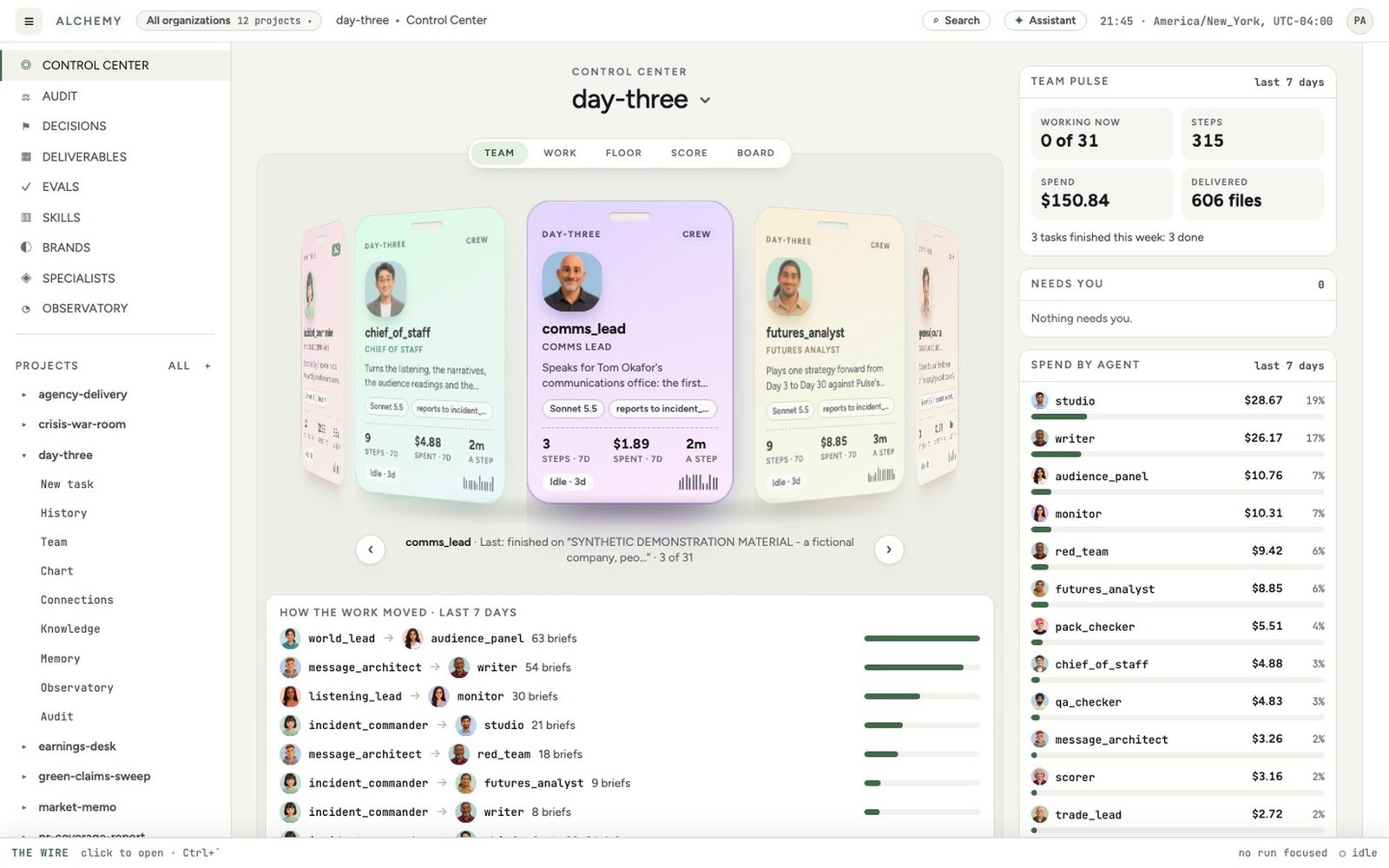
Who is on the team, what each agent may touch, and what each one did.
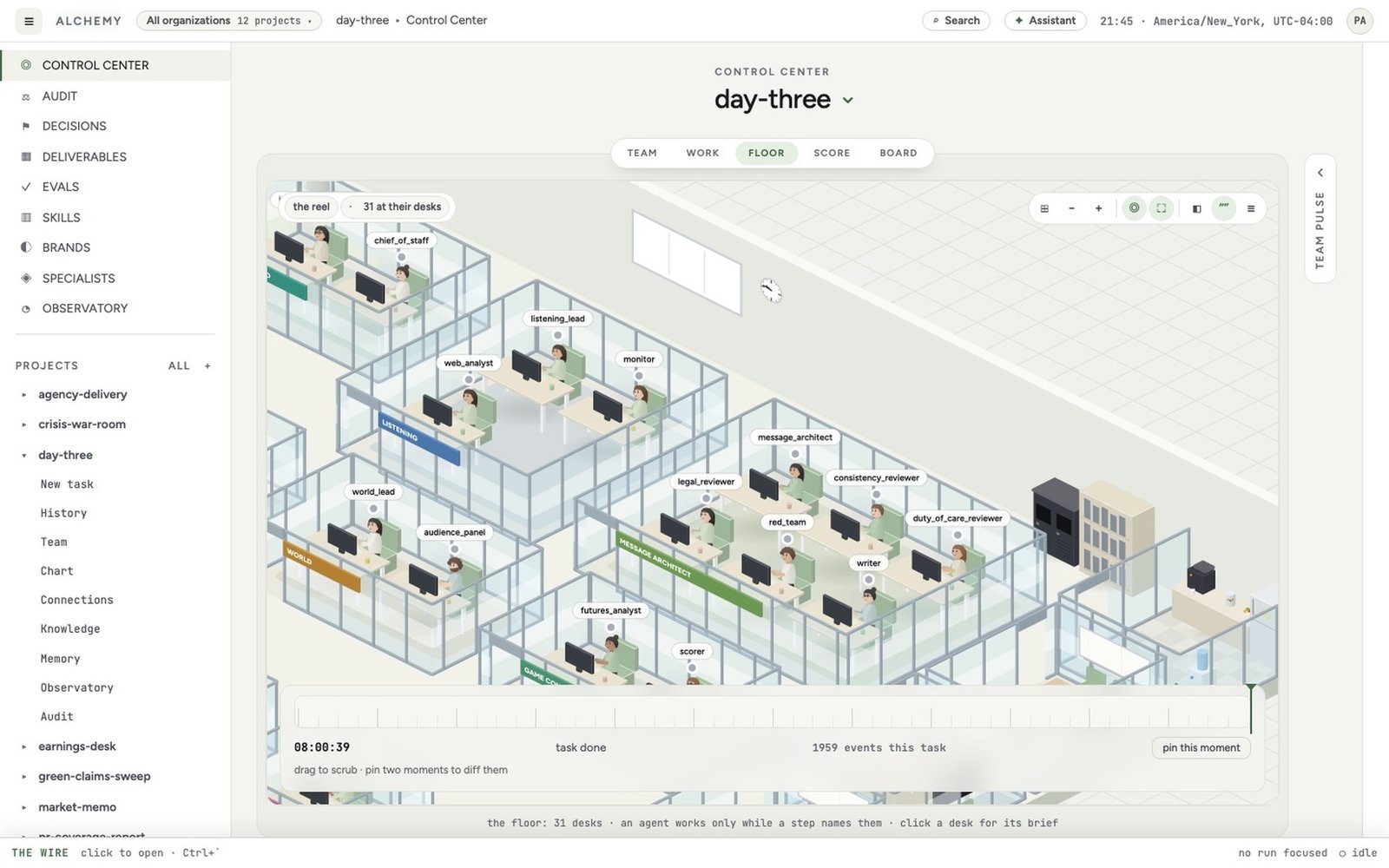
Where the work happened, desk by desk. Scrub to any moment of the run.
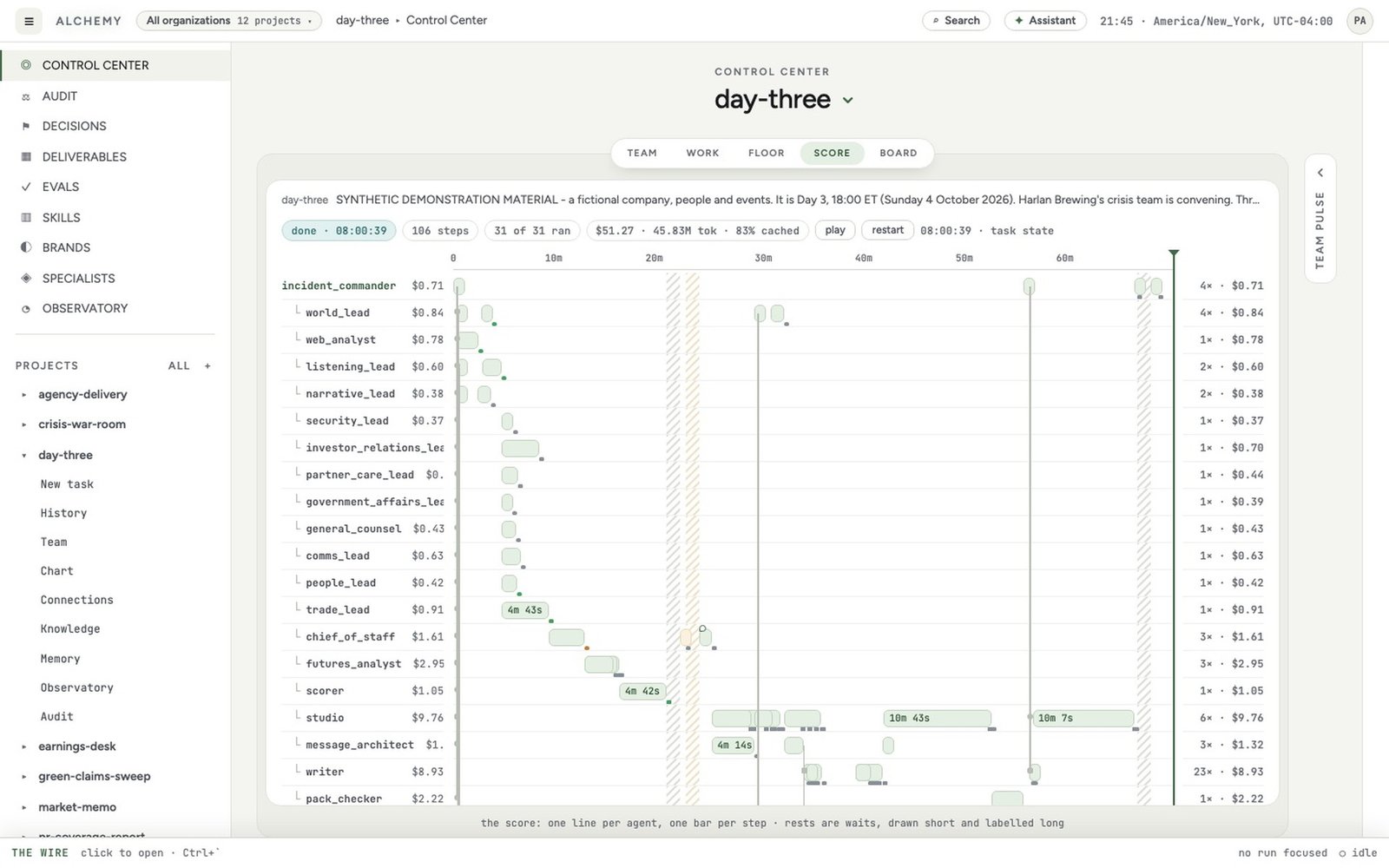
Every step, who took it and what it cost, one lane per agent.
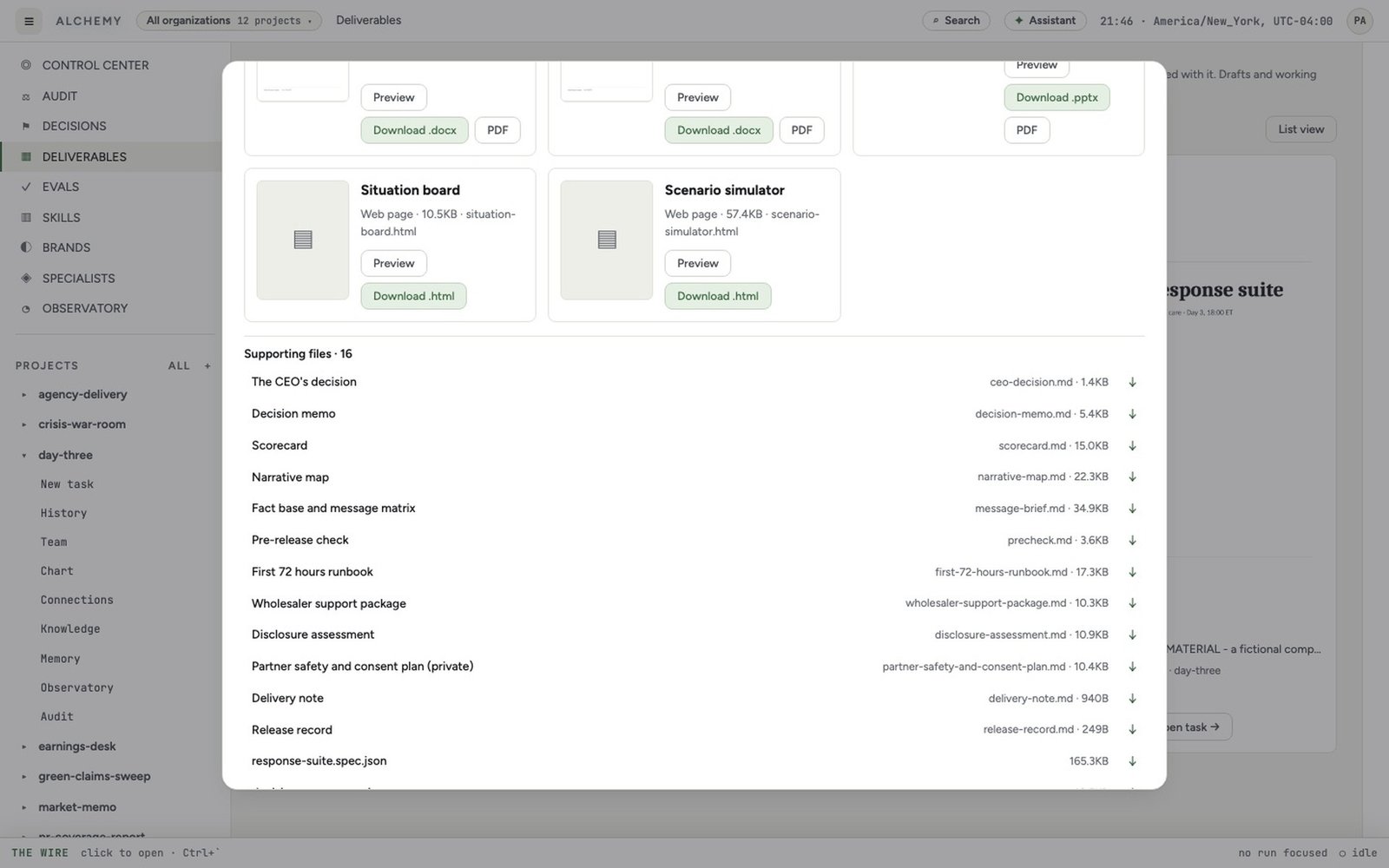
Every file the team made, and the pack the lead handed over.
Four steps from a description to a delivered, verifiable result.
Write one manifest: the agents, what each may touch, which actions need approval and what counts as done.
Hand it a piece of work. The lead plans and delegates, independent tasks run side by side, and you watch all of it from the control center.
Before a run can finish, an agent that did none of the work opens every deliverable against your definition of done.
A complete trail of every step: what each agent was given, what it did and what it changed. Encrypted on your disk, and anyone you share it with can check it has not been altered.
Agents need what any team needs: someone who sees the work, decides what matters and can prove what happened. Alchemy builds that in, so no team has to bolt it on.
Describe roles, reach and hand-offs once. Edit an agent with AI and keep every version, add skills with an administrator's approval, and start work from one box. Begin from 296 role templates or one of twelve ready projects.
The Control Center shows who is working, what is waiting on you and what each step cost. Replay any run, fork it from a decision, compare two runs, and let an AI audit read everything a project's agents did.
Mark pushes, filings, publishes and paid calls for a person. Give each agent only the files, tools and knowledge it needs. Cap spend per task, per project and per month, checked before every step.
What every agent was given, did and changed, kept by the system rather than the agent. Encrypted on your disk, hash-chained, and exportable as a bundle anyone can verify without us.
Each ships as a team you edit, not one you write from scratch. The work differs; the approvals, ceilings, independent checks and record are the same.
A crisis war room that works the whole response, a first-hour crisis desk, a release desk that checks every quote against the record, and a coverage report without inflated numbers. A person approves every release.
A green-claims sweep across markets and channels, and a red team for the market memo an investment committee will read. Every claim and figure traced to its source.
An earnings note checked against the filings, a commercial renewal compared form by form, and an importer's tariff refunds traced to the last claimable dollar.
A subcontractor's pull request checked before you pay for it, a vague ticket built into a tested change on GitHub and Jira, and a candidate submittal checked against the candidate's own CV.
Alchemy runs on infrastructure you control, encrypted at rest under a key kept apart from the data. People sign in with named accounts or your single sign-on, with roles down to each project. Actions you mark wait for a person, and no agent can approve. Nothing is sent to Agiliti.
Set a dollar ceiling on every task, a ceiling on paid calls, and optional daily and monthly limits per project and for the whole account. Limits are enforced before each step and hold even when many runs start at once. Model use bills to your own Anthropic account, never marked up.
One self-hosted process on Windows, Linux or macOS, or in Docker, built on Anthropic's Claude Agent SDK. A command-line tool, a setup check, health and metrics endpoints and an operations runbook come with it. GitHub, Jira, Confluence, MCP tool servers and HTTP APIs connect as governed actions.
For two years the question in every large company was whether an AI agent could do a task. It can. Then we watched good pilots die in the meeting where finance asked what it would cost at scale and security asked who approved the actions. Nobody could answer, so nobody signed.
A tool needs an operator. A worker needs four things a tool never did: a role, a manager, a budget and a record. Without them a hundred agents is not a workforce. It is a hundred pilots.
You have seen it on this page: a team you can watch, a decision that waited for a person, a record kept by the system rather than the agent. We call it the fabric: the layer every agent action passes through, which asks who is acting, what it may touch and what it costs, and writes the answer down. Governance is the runtime itself, not a rule each team bolts on later.
We will always print the limit beside the claim. Claude is the only model. A tool-server call outside a declared action is counted and capped, not gated. We have no logos yet. When something breaks, you will hear it from us first, with the record attached.
If you have a pilot that worked and cannot get it signed, build the organization with us for eight weeks. We will run your first real piece of work together. You will read the record on Monday, and you can put your name on the result.